
Overview
Relevant for SDK contributors and anyone deciding how far to trust the SDK
Each of the SDK's claims is enforced by a test or tool in the repository. Offline tests prove every op builds the right request, and a coverage test proves every documented endpoint has an op. The live suite records every call against a real tenant, and a report proves every op returned a 2xx or has a documented reason it can't. An end-to-end scenario then checks that AlertOps behaves as configured.
Key facts:
- Offline unit suite — 1,012 tests, no network, run in minutes.
- Index coverage — every endpoint in spec/index.md and spec/new-ui-index.md maps to an op.
- Live coverage — the latest report (docs/LIVE_COVERAGE.md) shows 784 ops: 656 exercised live with a 2xx, 128 exempt with a documented reason, 0 gaps.
- Behaviour scenario — tools/e2e_scenario.py verify: 13/13 checks passed (run 2026-11-03 23:54).
Before you start
Relevant for Contributors setting up a test environment
Install the development extra into a virtual environment:
python -m venv .venv && . .venv/bin/activate     # Windows: .venv\Scripts\activate
pip install -e ".[dev]"
This adds pytest, respx (HTTP mocking) and pytest-xdist. The live suite, the scenario tool and the sweeper also need a test tenant API key in the repository's .env file:
# .env (never commit this file)
ALERTOPS_API_KEY=your-test-tenant-api-key
Only point the live tools at a dedicated test tenant
The live suite creates and deletes real objects and opens real alerts. Its safety rules keep it away from pre-existing objects, but it still sends email notifications while it runs.
Offline unit suite
Relevant for Contributors checking a change before pushing
python -m pytest tests/unit
| Test file | What it proves |
| tests/unit/test_all_ops.py | Every one of the 784 registered ops, called on the sync client, sends the right method to the right URL with the right auth header (api-key for v2, x-api-key for v3, Authorization for session ops, none for anonymous ops). Every seventh op is also run on the async client. Op ids are unique and paths are well formed. |
| tests/unit/test_core.py | The call convention, envelope unwrapping, every paging style (including offset as a page index), the error map and body shapes, retries (GET retried on 503; POST not on 503 but on 429), flows with error forwarding on both clients, listeners and config precedence. |
| tests/unit/test_<module>.py | Flow logic and payload builders, for the eleven modules that have them (including semantic). |
| tests/unit/test_coverage.py | The index coverage test (next section). |
All HTTP is mocked with respx, so the suite never touches a real tenant. On the run used for this article, 1012 passed.
Index coverage test
Relevant for Contributors adding or renaming ops
tests/unit/test_coverage.py parses spec/index.md (more than 700 endpoint rows) and spec/new-ui-index.md into (method, base, normalised path) keys, with placeholders and numeric segments normalised to {}. Every key must match an op's path or one of its aliases.
python -m pytest tests/unit/test_coverage.py -q
A missing endpoint fails the test with <n> index endpoints have no SDK op: followed by a per-module list of the missing method and path. The only exclusions are rows that aren't AlertOps API endpoints (static assets, third-party telemetry, the WordPress help-center proxy).
Coverage runs from the index to the SDK
The test proves nothing documented is missing. An op for an undocumented path is allowed.
Live end-to-end harness
Relevant for Contributors running or writing live tests
The live suite in tests/live/ is skipped unless you opt in with ALERTOPS_LIVE=1. It reads the key from the repository .env, which wins over any exported key.
ALERTOPS_LIVE=1 python -m pytest tests/live
ALERTOPS_LIVE=1 python -m pytest tests/live/test_groups.py -q   # one module
In PowerShell, set $env:ALERTOPS_LIVE = "1" first. The harness supports pytest-xdist (-n 4): names stay unique per worker.
Rules every live test follows
| Rule | How the harness enforces it |
| Name everything sdktest-… | uniq("label") returns sdktest-<run>-<token>-label, so leftovers are sweepable. |
| Clean up even on failure | Register cleanup.delete(ao, path) or cleanup.add(...) immediately after create. Teardown runs LIFO and logs failures. |
| Never touch pre-existing objects | Account-wide settings are read, written back unchanged, verified and restored. |
| Notify only fake people | Only SDK-created users with @example.com emails (email_for(label)), email methods only. |
| Unique ingest source | The ingest URL routes by source, so make_api_integration gives each its own. |
| No billing or key changes | No plan, subscription or card writes; never regenerate the suite user's key. |
| Close what you open | Close or cancel every alert; disable and delete every workflow and maintenance window. |
| Serialise shared lists | tenant_lock(name) holds a file lock across xdist workers. |
Harness helpers
| Method | HTTP | What it does |
| ao / aao fixtures | none | Sync client for the session; a fresh async client per test. Both record every call. |
| world fixture | POST several | Shared, read-only objects: two users, a group, an escalation policy and an API integration. |
| make_user(ao, cleanup, label) | POST /users | Email-only @example.com user, teardown registered. |
| make_ep(ao, cleanup, label, quick_launch=False) | POST /escalation_policies/basic | Centralized, email-acknowledgement policy. quick_launch=True allows manual POST /alerts. |
| make_api_integration(ao, cleanup, label, ep_id, group_name) | POST /integrations/inbound | API integration with a unique source. |
| ingest_alert(api_url, payload) | POST ingest URL | Sends an event and returns the request id. |
| find_alert_from_ingest(ao, integration_id) | GET /integrations/inbound/log | Polls the inbound log until the integration opened an alert. |
The make_* helpers use raw ao.request calls so shared setup doesn't depend on the module under test; the tests themselves use SDK resources.
Notification action links need a real token from an alert email, so that test is opt-in:
ALERTOPS_LIVE=1 ALERTOPS_ACTION_LINK='<link from a real AlertOps alert email>' \
  python -m pytest tests/live/test_action_links.py
Live coverage report
Relevant for Contributors proving an op works against the real API
Every live call is recorded as {op, method, url, status} to tests/live/_out/calls-<RUN_ID>-<worker>-<pid>.jsonl (set ALERTOPS_RUN_ID to group sessions). tools/live_coverage.py matches each recorded URL back to an op by path template, so calls made through ao.request count too, and writes the report:
python tools/live_coverage.py                                   # docs/LIVE_COVERAGE.md
python tools/live_coverage.py --module groups --out build/cov_groups.md
python tools/live_coverage.py --run final,acklink,newui        # only these run ids
It prints a one-line summary: ops=… ok=… exempt=… gaps=… unmatched=… -> <out>. Each op lands in one bucket:
| Bucket | Meaning | Latest report |
| exercised live with 2xx | At least one recorded call succeeded. | 656 |
| exercised, error only, exempt | Called, never succeeded, and has a documented reason. | 104 |
| not exercised, exempt | Never called, for a documented reason (usually a safety rule). | 24 |
| gaps | No 2xx and no exemption. Must be 0. | 0 |
Exemptions
An op that can't get a 2xx on the test tenant needs an entry in tools/live_exemptions/<module>.py:
EXEMPT = {
    "groups.access.add_admins": "400 'Nothing to update': every eligible user already has implicit access "
    "(...) and admins_available returns [] on this tenant (verified with App Admin, Group Admin, Basic "
    "and a custom role)",
}
A reason must state the verified status or the safety rule that forbids the call. "Didn't try" is not a reason. Typical reasons in the report:
| Reason | Example ops |
| Safety rule: billing writes are never called | account.subscription.cancel, account.subscription.update_card |
| Plan-gated (402) | account.quick_start.update ("Package settings do not have Quickstart enabled"), call routing |
| Not entitled, or API keys rejected (403) | business_services.*, admin.locations.create |
| Session-only, or a token only a real notification carries | ai_chat.*, auth.assign_by_token |
| Server refuses on every testable alert | alerts.messages.acknowledge_message (400 "Alert is not enabled for acknowledge") |
Regenerate the report after adding ops
The report only counts ops that exist when it runs. After adding ops, re-run the live tests that exercise them and tools/live_coverage.py (several run ids can be combined: --run final,acklink,newui).
End-to-end behaviour scenario
Relevant for Anyone who needs proof that SDK-built configuration behaves correctly in AlertOps
tools/e2e_scenario.py proves the result is right: it builds an on-call stack through the SDK (mostly the semantic layer), fires real alerts, and checks timing and side effects.
python tools/e2e_scenario.py build      # create the "SDK-E2E" stack (idempotent)
python tools/e2e_scenario.py verify     # fire alerts, check behaviour, write build/e2e_report.md
python tools/e2e_scenario.py teardown   # delete everything recorded in tools/e2e_state.json
build creates four @example.com users (Alice, Bob and Carol rotate; Mona is the manager), the group SDK-E2E NOC with a 24x7 rotation, the SDK-E2E NOC Escalation policy (Primary at 0, Secondary at +2 min, Manager at +4 min), a workflow, an API integration, a technical service, a maintenance window, a heartbeat, a response play, a topic and an internal status page. Ids go to tools/e2e_state.json, so a re-run reuses them and teardown deletes exactly those. verify waits on real notifications, so it takes more than ten minutes.
| # | Check | What it proves |
| 1 | Rotation is 24x7 continuous; week 1 = Alice Primary, Bob Secondary, Carol off | The rotation plan is stored as planned. |
| 2 | EP ladder Primary(0) → Secondary(+2) → Manager(+2) | Role waits read back as [0, 2, 2]. |
| 3 | Workflow attached to EP | The workflow is linked. |
| 4 | Integration wired to EP and group | Routing is correct. |
| 5 | Primary Alice notified first | The ladder starts with the on-shift Primary. |
| 6 | Secondary Bob notified about 2 min later | Measured 2.1 min after Alice. |
| 7 | Manager Mona notified about 4 min after Alice | Measured 4.1 min after Alice. |
| 8 | Off-shift Carol not notified | The rotation, not group membership, decides who is paged. |
| 9 | Assignment at t0 stops escalation | No Bob or Mona notification in the 5 minutes after Alice is assigned. |
| 10 | Assigned alert owned by Alice | ao.alerts.assign sets the owner. |
| 11 | Workflow lowered priority when the alert was put On Hold | The workflow fired: High → Low. |
| 12 | Heartbeat reports Up after ping | ao.heartbeats.ping reaches the heartbeat. |
| 13 | Status page has the service group layout | The page layout written by set_layout reads back. |
The objects can also be inspected in the AlertOps UI. The policy's own timeline preview matches what check 2 read back and what checks 5–7 measured:
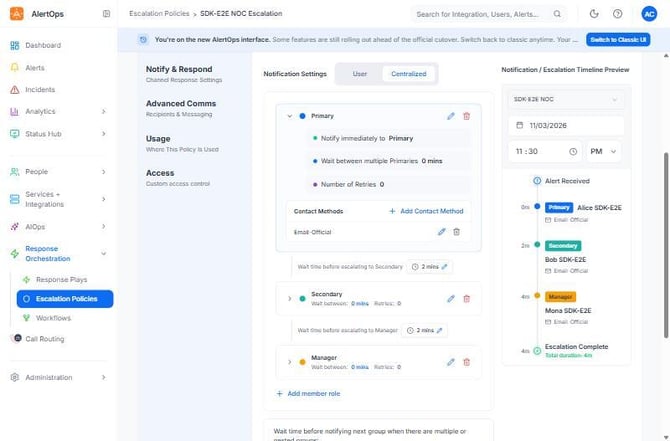
Figure 1. The policy built by the scenario, as the UI previews it: Alice (Primary) at 0 m, Bob (Secondary) at 2 m and Mona (Manager) at 4 m, the same ladder the verify step measured in real notifications.
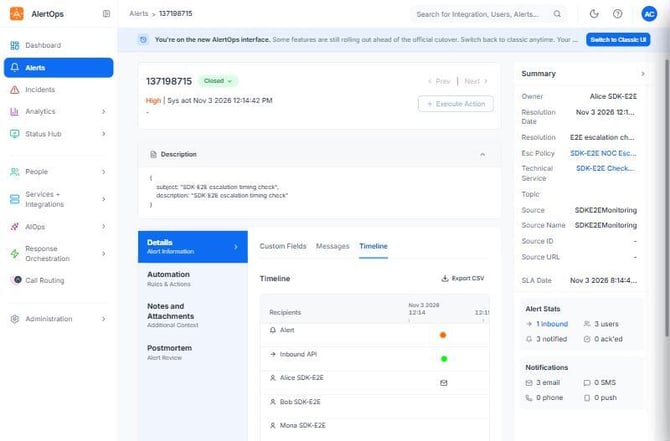
Figure 2. The alert from the escalation timing check (checks 5–8): Closed by the verify step, owned by Alice, routed through SDK-E2E NOC Escalation and the SDK-built technical service from source SDKE2EMonitoring. The timeline lists Alice, Bob and Mona, and the stats show 3 notified by email. Carol, who is off shift, isn't among the recipients.
Scenario objects aren't sdktest-* objects
The scenario names everything SDK-E2E … so it can be kept for UI review between runs. The sweeper doesn't touch it; remove it with teardown.
The sweeper
Relevant for Contributors cleaning up after an interrupted run
If a live run is killed before teardown, tools/sweep.py finds leftovers. It lists every object kind the suite creates (20 kinds, from users to status-page service groups) and matches names that start with the prefix.
python tools/sweep.py                                 # dry run: list leftovers
python tools/sweep.py --delete                        # delete them
python tools/sweep.py --prefix sdktest-11031455       # one run only
It's a dry run unless you pass --delete, and it refuses any prefix that doesn't start with sdktest. Kinds that can't be deleted with an API key (locations) are listed but never deleted.
Add a new endpoint
Relevant for Contributors extending the SDK
- Declare the Op in src/alertops/resources/<module>.py: method, path, base=, envelope=, paginate=, flags= (DESTRUCTIVE, SIDE_EFFECT, BILLING, NON_JSON, LEGACY) and doc=. Add other documented spellings as aliases=.
- Run python -m pytest tests/unit -q. The coverage test must pass, and test_all_ops.py picks up the new op automatically.
- Write a full lifecycle in tests/live/test_<module>.py (create, read back and assert, update, delete, confirm gone) and run it with ALERTOPS_LIVE=1. Fix the op against the real response and record surprises under "Gotchas (verified live)" in the module docstring.
- Run tools/live_coverage.py --module <root>. If the op can't get a 2xx, add a verified reason to tools/live_exemptions/<module>.py. Gaps must be 0.
- Regenerate the reference with python tools/gen_reference.py.
# src/alertops/resources/groups.py (illustration of the Op declaration style)
class Groups(Resource):
    governance = Op("GET", "/groups/{group_id}/governance",
                    doc="Where the group is used: escalation_policy[], integrations[], workflows[], ...")
Best Practices
Relevant for Contributors keeping the SDK trustworthy
Live tests
- Register cleanup on the line after the create, before any assertion that could fail.
- Assert the fields you set on read-back, not just a 2xx. The API reference comes from UI code and is sometimes wrong; the live API wins.
- Use the SDK resource under test, not ao.request, except for setup that belongs to another module.
- Run tools/sweep.py (dry run) after any interrupted session.
Exemptions
- Write the observed status and message into the reason, and re-check exemptions when the tenant's plan changes.
Configuration Examples
Relevant for Starting templates for common test runs
Example 1 — Full release verification
ALERTOPS_LIVE=1 ALERTOPS_RUN_ID=release python -m pytest tests/live
python tools/live_coverage.py --run release
python tools/e2e_scenario.py build
python tools/e2e_scenario.py verify
python tools/e2e_scenario.py teardown
python tools/sweep.py
Example 2 — A minimal live test
from tests.live.conftest import uniq

def test_group_round_trip(ao, cleanup):
    g = ao.groups.create(group_name=uniq("example"))
    cleanup.add("delete group", ao.groups.delete_if_exists, g.group_id)   # right after create
    assert ao.groups.find(uniq("example"))["group_id"] == g.group_id
    ao.groups.update_basic(g.group_id, group_name=uniq("example2"), description=["d"])
    assert ao.groups.get(g.group_id).group_name == uniq("example2")
    assert ao.groups.delete_if_exists(g.group_id) is True
    assert ao.groups.delete_if_exists(g.group_id) is False
Troubleshooting
Relevant for Anyone debugging the test tooling
Every live test is skipped
- ALERTOPS_LIVE=1 isn't set in the shell that runs pytest. The skip reason is "live tests need ALERTOPS_LIVE=1".
- The .env file has no ALERTOPS_API_KEY: the ao fixture skips with "no ALERTOPS_API_KEY in .env".
test_coverage fails with "index endpoints have no SDK op"
- A documented endpoint has no op. Add the op, or add the documented spelling to an existing op's aliases=.
The coverage tool reports gaps
- The op has no 2xx in the recorded runs (check --run didn't leave out the run that exercised it). Exercise it in the live test, or add a verified reason to tools/live_exemptions/<module>.py.
The scenario's escalation checks fail
- The checks accept Bob between 1.5 and 4 minutes and Mona between 3.5 and 7 minutes after Alice. If notifications were slow on the tenant, re-run verify.
- verify raises "alert did not open" when no new Open alert from SDK-E2E Monitoring API appears within 90 seconds. Run build first, and check that the integration still exists.
Leftover sdktest-* objects on the tenant
- A run was interrupted before teardown. Run tools/sweep.py to list them, then tools/sweep.py --delete.
Related Articles
- Getting Started with the AlertOps Python SDK
- Calling the API from Python: Parameters, Pagination and Errors
- Async Client and Composable Flows in the Python SDK
- Planning On-Call Setups with the AlertOps Semantic Layer
- Working with Alerts in the AlertOps SDKs
Need help?
Email support@alertops.com or contact your AlertOps representative.